
In the digital marketing landscape, where the attention span of the average consumer is shorter than ever, grabbing and holding attention is key. This is where infographics come in—a visual representation of information designed to convey complex data quickly and clearly. Not only do infographics help simplify intricate concepts, but they also serve as powerful tools for lead generation and increasing sales. In this comprehensive guide, we will explore how infographics can boost your sales, the process of creating and distributing high-quality infographics, different types of infographics, SEO benefits, and the best platforms for sharing them.
The Power of Infographics in Lead Generation
Infographics combine compelling visuals with valuable information to tell a story that resonates with your audience. This visual storytelling technique is incredibly effective in grabbing attention and can be a crucial component of your lead generation strategy. Here’s how infographics help increase sales:
- Enhanced Engagement: Infographics are more engaging than text alone. They use colors, shapes, and symbols to make data and information more digestible and memorable, helping you communicate more effectively with your audience.
- Increased Brand Awareness: By including your brand logo, colors, and a link to your website, infographics help build brand awareness. Every share of your infographic is another opportunity for brand exposure.
- Boosted Conversion Rates: Infographics can guide viewers through a narrative that leads them to a call to action, encouraging them to engage with your brand further—whether it’s signing up for a newsletter, downloading an eBook, or making a purchase.
- Authority and Credibility: Well-researched infographics with credible data sources position your brand as an authority in your industry. This trust is critical for converting leads into customers.
High-Quality Infographic Creation
Creating high-quality infographics involves more than just putting some numbers on a colorful background. It requires a strategic approach to design, data, and storytelling. Here’s how you can create compelling infographics:
- Define Your Objective: What do you want to achieve with your infographic? Whether it’s educating your audience, showcasing your product’s benefits, or generating leads, having a clear objective will guide the design and content.
- Know Your Audience: Understand who your audience is and what they care about. This knowledge will help you tailor the content and design of your infographic to meet their needs and preferences.
- Research and Gather Data: High-quality infographics are backed by solid research. Use credible sources to gather data and statistics that support your message. Remember to cite these sources in your infographic to build credibility.
- Create a Compelling Narrative: An infographic should tell a story. Organize your data logically, leading your audience from one point to the next seamlessly. The narrative should build towards a conclusion that reinforces your objective.
- Focus on Design: A visually appealing design is crucial. Use colors that align with your brand, and make sure the text is easy to read. Icons, charts, and illustrations can help convey information more effectively than text alone.
- Keep It Simple: Avoid cluttering your infographic with too much information. Focus on key points and use visuals to break up text and make the information more digestible.
- Include a Call to Action: Every infographic should have a purpose. Include a call to action that encourages viewers to take the next step, whether it’s visiting your website, contacting your sales team, or sharing the infographic.
Types of Infographics
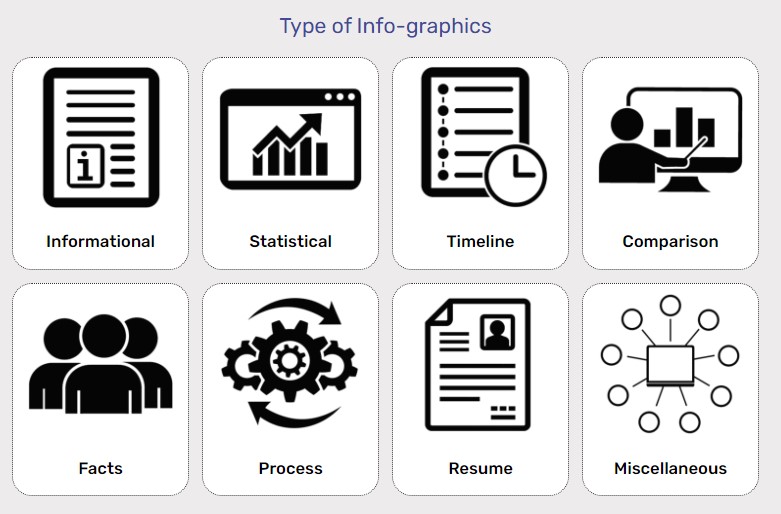
There are various types of infographics, each serving a different purpose. Understanding these types will help you choose the right format for your message:
- Statistical Infographics: These focus on data and statistics, using charts, graphs, and numbers to convey information. They are ideal for presenting survey results, market research, or any data-driven story.
- Informational Infographics: These are used to explain a concept or process. They break down complex information into easy-to-understand sections, often using icons and illustrations.
- Timeline Infographics: These visually represent the progression of events over time. They are great for showing the history of a company, the development of a product, or a project timeline.
- Process Infographics: These infographics simplify a process into a step-by-step guide. They are useful for tutorials, product instructions, or explaining procedures.
- Comparison Infographics: These infographics compare two or more items, such as products, services, or concepts. They help audiences make informed decisions by highlighting differences and similarities.
- Hierarchical Infographics: These display information in a structured format, showing the relationship between different elements. They are often used in organizational charts or to illustrate classifications.
- Geographic Infographics: These use maps and charts to represent data tied to specific locations. They are effective for showing regional statistics or the geographical impact of a topic.
SEO Benefits of Infographic Distribution
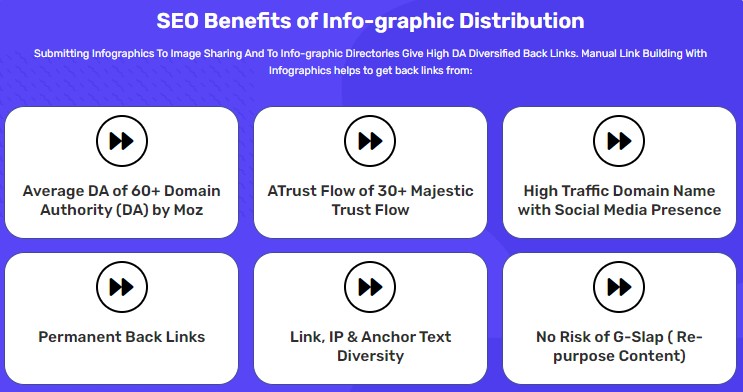
Infographics aren’t just visually appealing; they can also significantly enhance your SEO strategy. Here’s how:
- Backlink Generation: High-quality infographics are highly shareable. When other websites use your infographic, they often link back to your site, increasing your backlink profile and improving your search engine rankings.
- Increased Dwell Time: Infographics can keep visitors on your page longer as they engage with the content. This increased dwell time is a positive signal to search engines that your content is valuable, which can boost your rankings.
- Improved Social Signals: Infographics are popular on social media platforms. Shares, likes, and comments can increase your social signals, indirectly benefiting your SEO.
- Optimized Image Search: Infographics can rank in image search results. By optimizing your infographics with relevant keywords in the file name, alt text, and description, you can increase your visibility in search engines.
- Enhanced Content Value: Search engines prioritize content that provides value to users. A well-designed infographic with useful information can enhance the overall value of your content, helping you rank higher.
Infographic Distribution Strategy
To maximize the reach and impact of your infographics, it’s crucial to have a distribution strategy in place. Here’s how you can distribute your infographics effectively:
- Website and Blog: Publish your infographic on your website and blog. This not only provides valuable content for your visitors but also helps with SEO.
- Social Media Platforms: Share your infographic on platforms like Facebook, Twitter, LinkedIn, Instagram, and Pinterest. Each platform has its own strengths; for example, Pinterest is particularly effective for infographics due to its visual nature.
- Email Marketing: Include infographics in your email newsletters to provide valuable content to your subscribers. This can increase engagement and click-through rates.
- Outreach to Influencers: Reach out to industry influencers and bloggers who may be interested in sharing your infographic with their audience. This can significantly expand your reach.
- Infographic Directories: Submit your infographic to infographic directories. These platforms allow users to discover and share infographics, increasing your chances of gaining backlinks and traffic.
List of High DA Infographic Directories
Submitting your infographics to high domain authority (DA) directories can boost your SEO and increase your visibility. Here are some top infographic directories with high DA:
- Visual.ly (DA 85): One of the most popular infographic directories. Visual.ly allows you to submit your infographic for free, making it a great platform for exposure.
- Infographic Journal (DA 54): A blog-style site that features infographics on a variety of topics. Submissions are free but may take some time to be published.
- Daily Infographic (DA 61): Curates and publishes infographics daily. Submissions are free, but they do have a quality standard.
- Infographics Archive (DA 45): Offers both free and paid submission options. A well-organized site that categorizes infographics by topic.
- Cool Infographics (DA 57): Managed by a professional infographic designer, this site features high-quality infographics on a range of topics.
- Graphs.net (DA 49): A platform dedicated to infographics and data visualizations. Free submissions are available with an option for paid features.
- Infographic Plaza (DA 41): Allows you to submit your infographic for free. They accept a wide range of topics, making it a versatile platform for different industries.
List of High DA Photo Sharing Sites
Infographics are not just confined to infographic directories. Photo-sharing sites also offer a great platform to reach a wider audience. Here are some high DA photo-sharing sites to consider:
- Flickr (DA 92): A well-known platform for sharing photos and graphics. It’s a great place to upload your infographic and link back to your site.
- Pinterest (DA 94): One of the most popular visual discovery platforms. Infographics perform exceptionally well on Pinterest due to its visual nature.
- Instagram (DA 99): While primarily a photo-sharing app, Instagram can be a powerful platform for infographics, especially when combined with engaging captions and hashtags.
- Imgur (DA 92): Known for its viral content, Imgur allows users to share and discover images, including infographics. It’s an excellent platform for reaching a broad audience.
- Photobucket (DA 90): A long-standing photo-sharing platform that allows you to upload images, including infographics, and share them with your audience.
- DeviantArt (DA 92): A community of artists where you can share infographics as part of your portfolio. It’s particularly effective for creative and visually appealing designs.
- 500px (DA 82): Primarily focused on high-quality photography, but infographics can also gain traction here, especially if they are visually stunning.
Infographics are a versatile and powerful tool in digital marketing, especially for lead generation and sales growth. By combining data with compelling visuals, infographics can simplify complex information, increase engagement, and enhance brand authority. When effectively created and distributed, they can significantly boost your SEO and expand your reach across various platforms.
Get in Touch
Website – https://www.webinfomatrix.com
Mobile – +91 9212306116
Whatsapp – https://call.whatsapp.com/voice/9rqVJyqSNMhpdFkKPZGYKj
Skype – shalabh.mishra
Telegram – shalabhmishra
Email – info@webinfomatrix.com
 Inforgraphics Marketing Firm